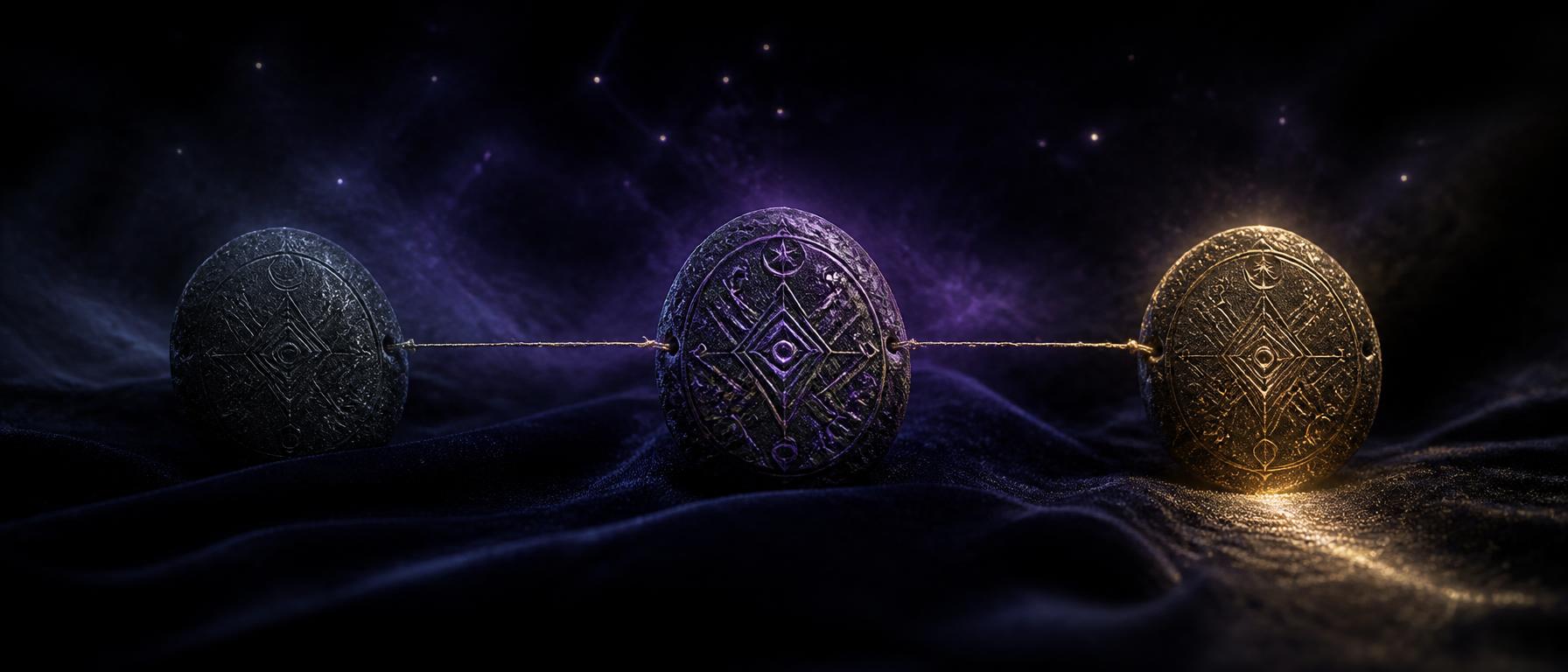
Three-Rune Reading: Past, Present and Your Next Step
Aug 7, 2026 · 13 min
One rune gives you a symbol. Three runes give you a relationship between symbols — and that is where the story begins.
A single rune can give you a symbol to sit with. Three runes create something more interesting: a relationship.
One may seem to describe what brought you here. Another can highlight what feels active now. The third can shift the question away from “What will happen?” and toward something more useful:
“What can I do with what I understand?”
That is the idea behind this three-rune reading.
The positions are simple:
Past.
Present.
Next Step.
You do not need to know every rune by heart before you begin. The aim is not to memorise twenty-four definitions. It is to notice how three different symbols change when they are placed beside one another.
Why Next Step instead of Future?
Many three-card and three-symbol spreads are described as Past, Present and Future.
We use a slightly different third position.
Next Step.
The distinction matters.
“Future” can encourage you to wait for a prediction to prove itself. “Next Step” asks you to remain part of the story.
Your circumstances can change. Other people make their own choices. You can change your mind. New information can appear.
The third rune therefore does not need to tell you what is destined to happen.
Instead, ask:
What quality would help me move forward?
What am I not considering?
What deserves action?
What deserves patience?
That small change makes the spread less about watching the future and more about understanding your position within it.
Draw your three runes
Think of one situation you want to understand more clearly.
Nothing is saved. Your draw stays in this browser only.
The influence, pattern or decision that still travels with you.
What still shapes this?
The tension, resource or truth that is most active today.
What needs attention now?
A proportionate attitude, question or action — never a fixed outcome.
What can I choose to do?
Ancient symbols, modern reflection
The Elder Futhark is the earliest commonly classified runic alphabet and contains 24 characters.
Historically, runes were first and foremost a writing system. Elder Futhark inscriptions appear across Germanic-speaking regions in the early centuries CE. Later, Scandinavian runic writing developed into Younger Futhark, the smaller rune row strongly associated with the Viking Age.
The three-position reflective spread used here is a modern practice inspired by rune symbolism. Zodiac Fortune Club does not present it as a documented Viking ritual.
That distinction does not make the symbols less interesting.
It simply allows us to appreciate two things at once: the historical runes as writing, and the modern practice of using their reconstructed names and symbolic associations as prompts for reflection.
Frequently asked questions
Do I need to know all 24 runes?
No. Begin with the meanings shown alongside your draw and learn gradually. Repeated exposure is more useful than trying to memorise every meaning at once.
Can I ask about love?
Yes. Use questions that focus on understanding the relationship, your own choices and what can be observed.
Can I ask about work?
Yes. Past–Present–Next Step works especially well for decisions, transitions and situations where you need a clearer perspective.
Should I draw again if I dislike a rune?
Usually, sit with the first spread for a while. Immediately replacing an uncomfortable rune can remove exactly the question that deserved attention.
Can the same rune appear twice?
In this Zodiac Fortune Club three-rune interaction, the three runes are drawn without repetition, so each position receives a different rune.
Are reversed runes used?
This article follows the existing Zodiac Fortune Club rune system. Reversals should only appear if they are already part of that established system.
Is Past–Present–Next Step an ancient Viking spread?
No. The runes themselves have ancient historical origins as writing symbols. The three-position reflective spread is a modern way of working with rune symbolism.