
Calculate your birth-date numbers
Enter your date of birth to see your Birth Number, Life Path Number and this year's Personal Year Number, calculated with the same formulas the Zodiac Fortune Club tools use.
Calculated in your browser. Your birth date is never stored or sent anywhere.
Some numbers arrive before we give them meaning. They repeat in addresses, dates, receipts or moments we remember. Others are calculated deliberately from a birth date.
Numerology places these experiences inside a symbolic system. It does not prove that one number controls events, but it can offer a consistent way to reflect on themes such as initiative, patience, expression or change.
The most useful question is therefore not:
Which number will make me win?
It is:
Which numbers form a meaningful personal pattern—and how can I use that pattern without mistaking symbolism for certainty?
This guide uses three layers: your Birth Number, your Life Path Number and your Personal Year Number. Together, they create a small set of numbers rather than one supposedly magical answer.
The quick method
To create your personal lucky-number set:
- Reduce the day you were born to find your Birth Number.
- Add the digits of your complete birth date to find your Life Path Number.
- Add your birth day, birth month and the digits of the current year to find your Personal Year Number.
- Expand the core numbers into related calendar-date families.
- Use the set as a symbolic prompt—not as a guarantee.
Different numerology traditions use different names and calculation rules. Zodiac Fortune Club uses the method below because it is clear, repeatable and easy to check.
First: what does “lucky number” mean here?
In this guide, a lucky number is a number chosen through a symbolic numerology method. It may represent:
- a lasting personal theme;
- a quality you want to remember;
- a useful date for reflection;
- a number that feels connected with your identity;
- a simple ritual or journaling prompt.
It does not mean that the number changes the odds of any random or chance-based outcome. Numerology is a symbolic language for reflection, never a prediction method.
That boundary makes the practice more interesting, not less. A symbol can be meaningful without pretending to be evidence.
Step 1: Calculate your Birth Number
Your Birth Number comes from the day of the month on which you were born.
If you were born on a single-digit day, that is already your Birth Number.
Examples:
- Born on the 4th → Birth Number 4
- Born on the 8th → Birth Number 8
For a double-digit day, add the digits until you reach a single number.
Examples:
- Born on the 14th → 1 + 4 = 5
- Born on the 19th → 1 + 9 = 10 → 1 + 0 = 1
- Born on the 27th → 2 + 7 = 9
Some numerology schools preserve 11 and 22 as Master Numbers. In this guide, you may keep the master meaning while also reading the reduced number:
- 11 also carries the foundation of 2
- 22 also carries the foundation of 4
Your Birth Number is the most immediate part of the set. It is often used to describe the manner in which you begin, react or make yourself visible.
Birth-number families
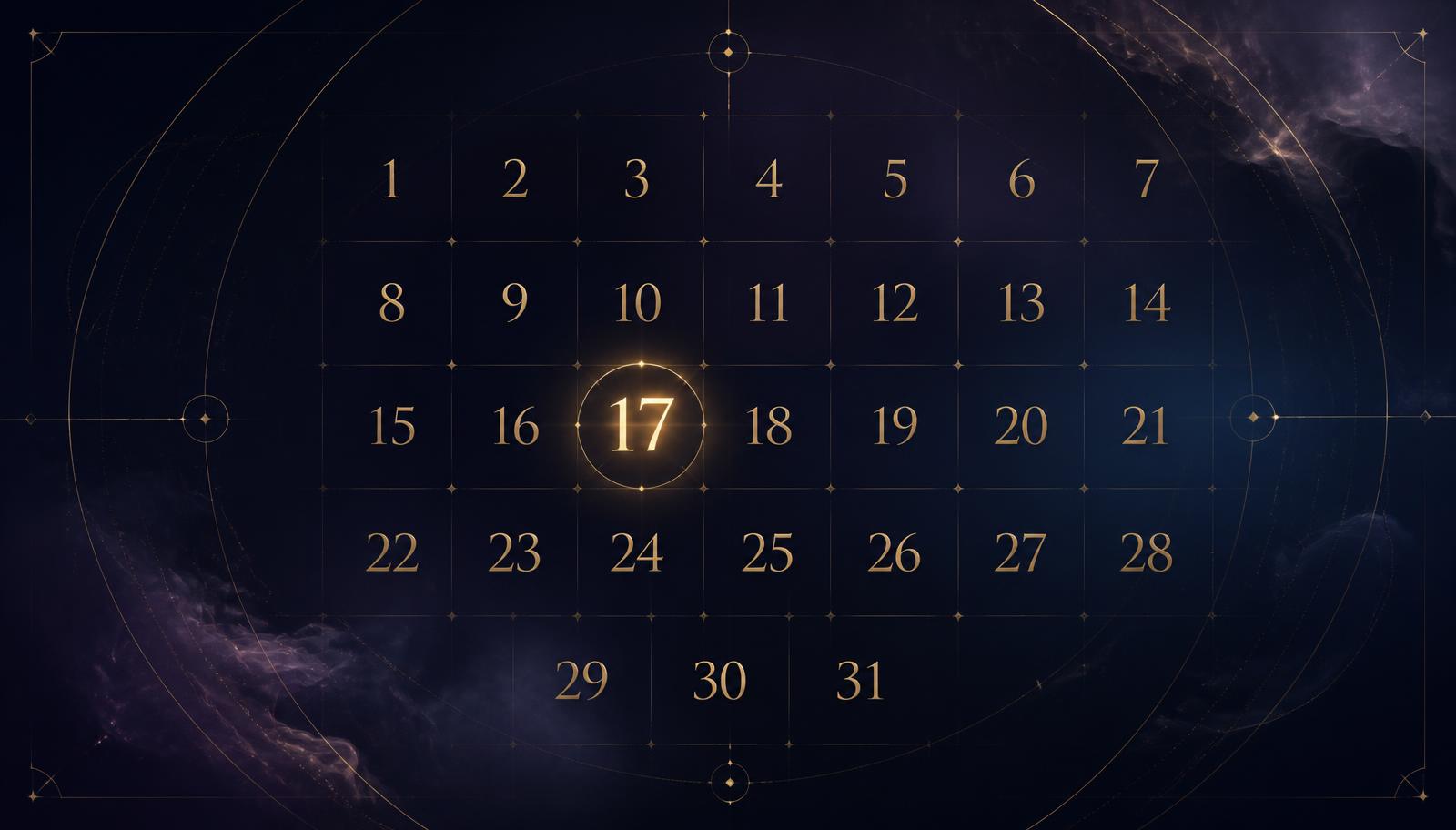
Calendar dates naturally group into families because they reduce to the same single digit:
| Core number | Related birth dates |
|---|---|
| 1 | 1, 10, 19, 28 |
| 2 | 2, 11, 20, 29 |
| 3 | 3, 12, 21, 30 |
| 4 | 4, 13, 22, 31 |
| 5 | 5, 14, 23 |
| 6 | 6, 15, 24 |
| 7 | 7, 16, 25 |
| 8 | 8, 17, 26 |
| 9 | 9, 18, 27 |
These related dates can become part of your wider symbolic set.
Read next
Chosen for you by zodiac sign and topic.
- Life Path Number Calculator: What Your Number Means
Calculate your Life Path number and read the full meaning of all nine main numbers plus the three master numbers.
Shared themes: Numerology
May 30, 2026
- Personal Year Number: What Energy Rules Your Year?
Your Personal Year number is a one-digit theme that changes every calendar year. Here is how to calculate and read it.
Shared themes: Numerology
May 22, 2026
- Your Personal Month Number for October 2026
October 2026 reduces to a month number of 1 — but your own Personal Month depends on your Personal Year. Calculate it and read the theme for numbers 1–9.
Shared themes: Numerology
Aug 15, 2026