The September equinox arrives on 23 September 2026 at 00:05 UTC. Astronomically, it is a precise moment in Earth's yearly journey around the Sun. In the Northern Hemisphere it marks the beginning of astronomical autumn; south of the equator, astronomical spring begins.
For Zodiac Fortune Club, the equinox is useful for another reason too. In tropical astrology, this point marks the beginning of Libra season — a symbolic framework associated with balance, relationship, fairness and perspective.
Those two ideas should not be confused.
The astronomy describes what Earth and the Sun are doing. The Libra themes below are a reflective language we choose to place alongside that real event.
That distinction makes the equinox more interesting, not less.
September Equinox 2026 at a glance
- Date: 23 September 2026
- Exact astronomical moment: 00:05 UTC
- UK: 01:05 BST
- Estonia and Finland: 03:05 EEST
- Germany: 02:05 CEST
- Northern Hemisphere: astronomical autumn begins
- Southern Hemisphere: astronomical spring begins
- Tropical astrology: Libra season begins
- Reflection themes: balance, reciprocity, priorities, perspective and direction
What actually happens at the September equinox?
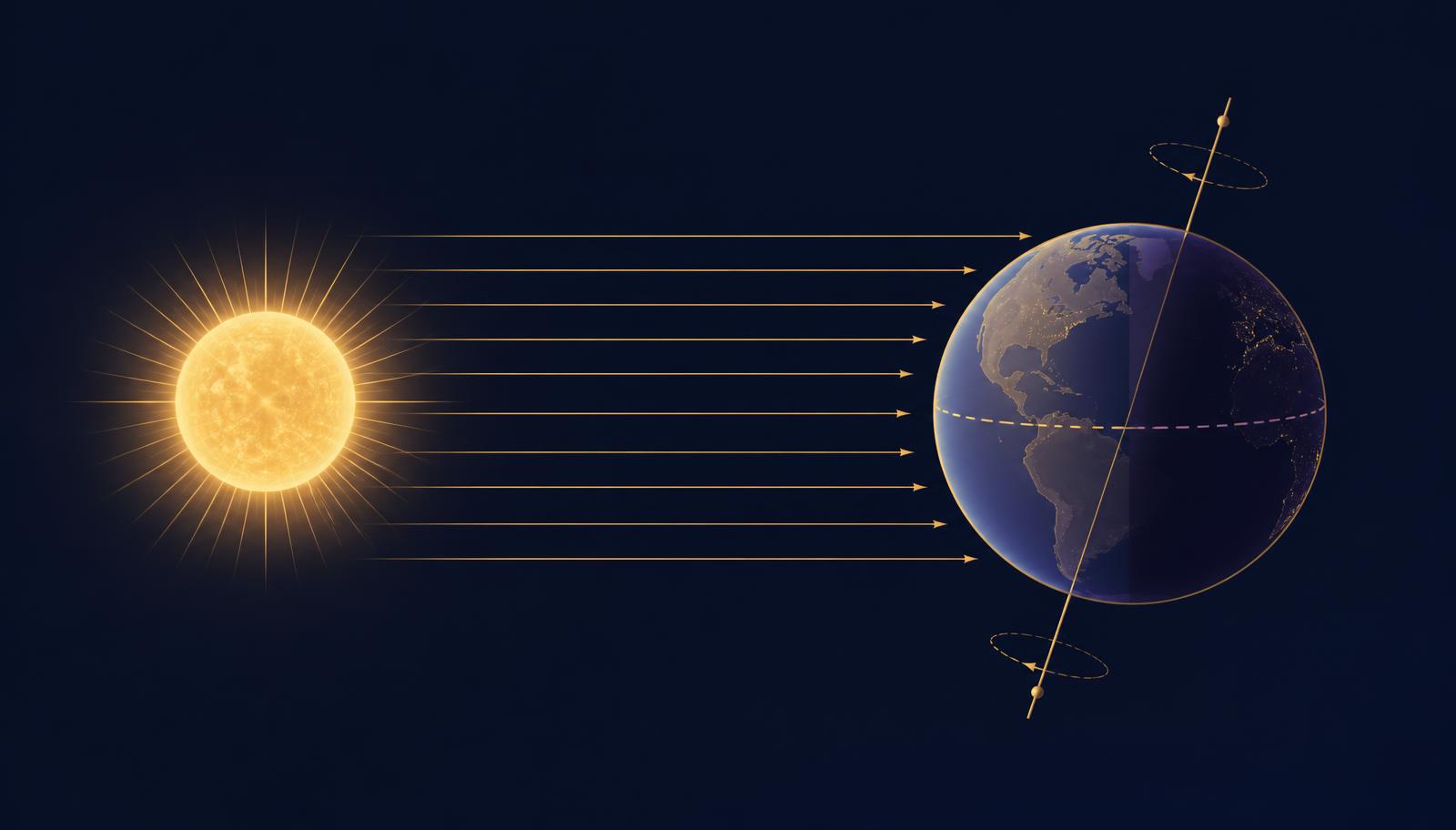
Earth's seasons are created primarily by the tilt of Earth's rotational axis as our planet orbits the Sun.
That tilt does not disappear at the equinox.
Instead, the geometry reaches a point where neither hemisphere is tilted toward the Sun more than the other. The Sun's apparent path crosses the celestial equator, and sunlight is distributed much more evenly between the Northern and Southern Hemispheres.
The September equinox is therefore a moment, not an entire day.
After it, the Northern Hemisphere continues towards shorter days and the December solstice. The Southern Hemisphere moves further into its spring.
This is why calling the event simply “the first day of autumn” only tells half the story. It depends on which hemisphere you are in.
Are day and night really equal at the equinox?
Almost — but not perfectly.
The word equinox comes from ideas meaning “equal” and “night”, which makes it easy to assume that every location receives exactly 12 hours of daylight and 12 hours of darkness.
Real sunrise and sunset measurements are more complicated.
Earth's atmosphere bends sunlight near the horizon. We can therefore see the Sun for a short time even when its geometric position has moved below the horizon.
Sunrise and sunset are also measured using the visible edge of the solar disc rather than only its centre.
The result is that daylight on the equinox is often slightly longer than 12 hours.
The astronomical event is still a point of exceptional seasonal balance — just not a perfectly symmetrical clock split everywhere on Earth.
Read next
Chosen for you by zodiac sign and topic.
- New Moon in Libra: What Do You Want to Rebalance?
The October 2026 New Moon falls in Libra. Explore symbolic themes around relationships, balance, agreements, boundaries and all 12 zodiac signs.
Shared themes: Love · Work & Career · Health & Self-Care
Aug 16, 2026
- Full Moon in Aries: What Are You Ready to Act On?
The September 2026 Full Moon falls in Aries. Explore reflection themes around courage, boundaries, relationships, action and all 12 zodiac signs.
Shared themes: Love · Work & Career · Health & Self-Care
Aug 14, 2026
- Venus Retrograde 2026: What Deserves a Second Look?
Venus appears to turn retrograde from 3 October to 14 November 2026, moving from Scorpio back into Libra — a symbolic invitation to review attraction, reciprocity and personal values.
Shared themes: Love · Health & Self-Care
Aug 15, 2026